
***From Beth Moore@ LPM Blog
1. A Complete Concordance (like Strong’s). Find one that corresponds with your translation (Strong’s for KJV, The NIV Exhaustive Concordance, etc.)
2. A good Systematic Theology Book. Here are two great choices:
*Systematic Theology by Wayne Grudem
*Christian Theology by Millard J. Erickson
3. A good Bible Dictionary – Holman Illustrated Bible Dictionary is terrific. There are also many others.
4. For beginners: Several two (or few) volume sets of Bible Commentaries (My mentor started me on The Bible Knowledge Commentary, Old Testament and New Testament Volumes, but there are plenty out there. Your pastor may be able to recommend a set that is most reflective of your church’s approach.)
*You can access many commentaries free of charge online: BibleGateway.com, BlueLetterBible.com, etc.
5. The 1st multi-volume set of commentaries I’d recommend is The Expositor’s Bible Commentary (12 Volume Set). They are consistently well written, thought provoking and really practical for teachers. You also don’t have to know basics about the original languages to understand them (They give good insights into the original languages and frequent definitions but the authors are not assuming you have a working knowledge of Hebrew or Greek). If you really love that set and want to keep going, the next step I’d take would be the full volume sets of NIVAC (NIV Application Commentary) and NAC (New American Commentary). Want to keep going?? The next step after that (where you’ll more often need some basic knowledge of original languages) is the Word Biblical Commentary series and New International Commentary of the OT/NT series. And it goes on and on, Sweet Thing! And it’s a head spinner and a blast.
6. A Comparative Study Bible with multiple translations listed side-by-side.
And, then, start saving your money for Bible Software. Melissa and I have personally used the following programs and would happily recommend them to you:
- Logos (Beth)
- Wordsearch (Beth)
- BibleWorks (Melissa)
- Accordance (Melissa)
Last thing:
A few of my favorite foundational books about the Bible are:
Baxter’s Explore the Book
Fee and Stuart’s How to Read the Bible For All It’s Worth
Fee and Stuart’s How to Read the Bible Book by Book
Last Last thing (this is Melissa now):
In terms of selecting commentaries, I highly recommend purchasing and consulting John Glynn’s book Commentary & Reference Survey. Glynn’s book will help you make the most of your money when you purchase commentaries and reference works. The book is basically one massive biblical studies bibliography and he updates it often. I think it is already in its tenth edition or something. When it comes to commentaries, not all volumes in a series are written equally. In other words, some are better than others and so you may not want to purchase an entire series. Sometimes you can grab an entire series for a great price but other times it isn’t economical or necessary. Instead, you may want to pick and choose individual volumes within a series and Glynn will help you do just that. Also check out www.bestcommentaries.com for a similar idea online. It is an amazing website. My favorite feature is the “forthcoming commentaries” tab where you can browse through the commentaries that are due to be published over the next few years. Also, it goes without saying that commentaries, just like every written work, should be read carefully and critically. If they are read in such a manner, they can be invaluable to one’s study of the Bible.
A very basic beginner’s biblical/theological library might look a little bit like this:
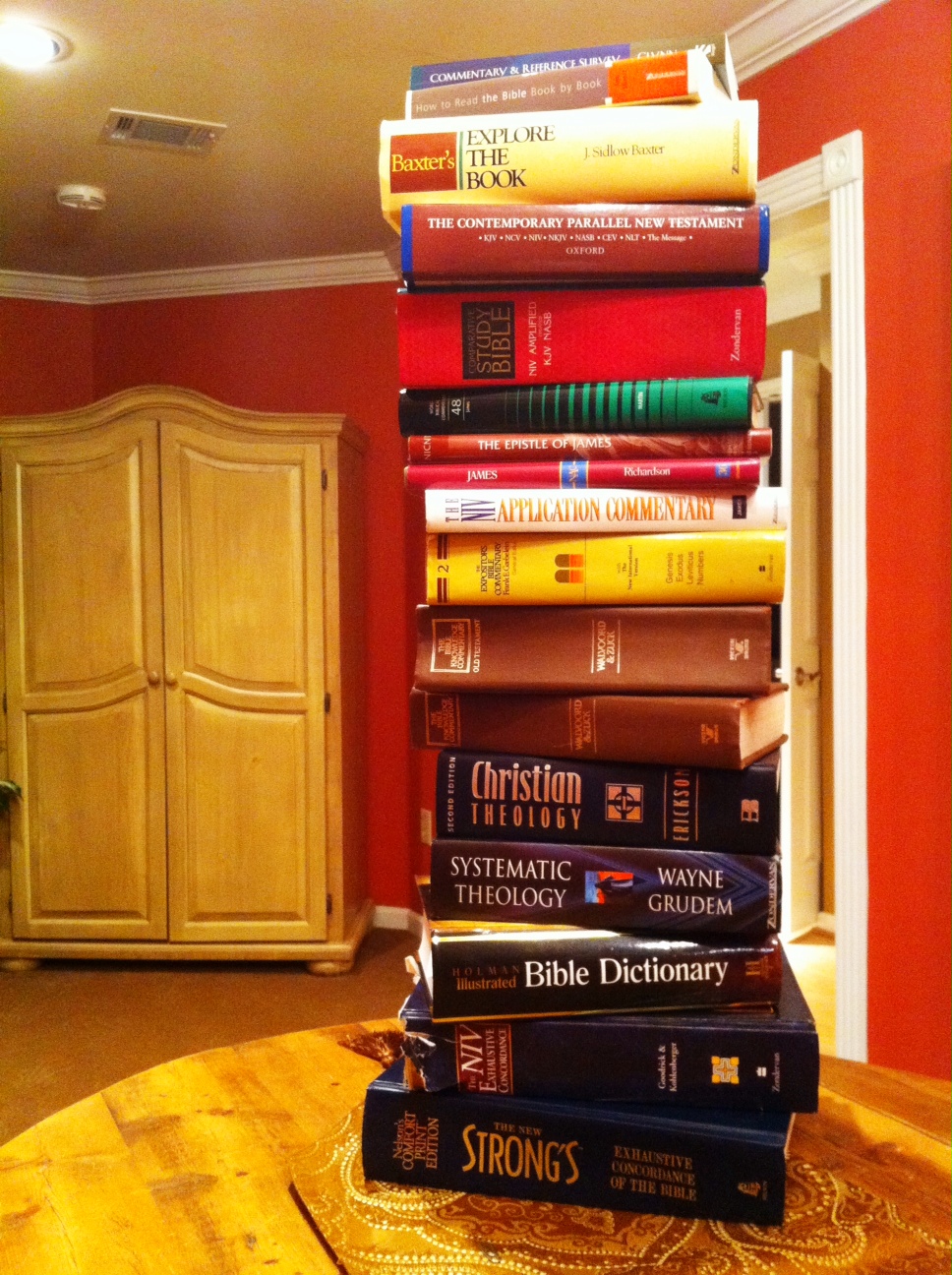
Are we having fun yet??

No comments:
Post a Comment